In my inbox
What the digest actually looks like
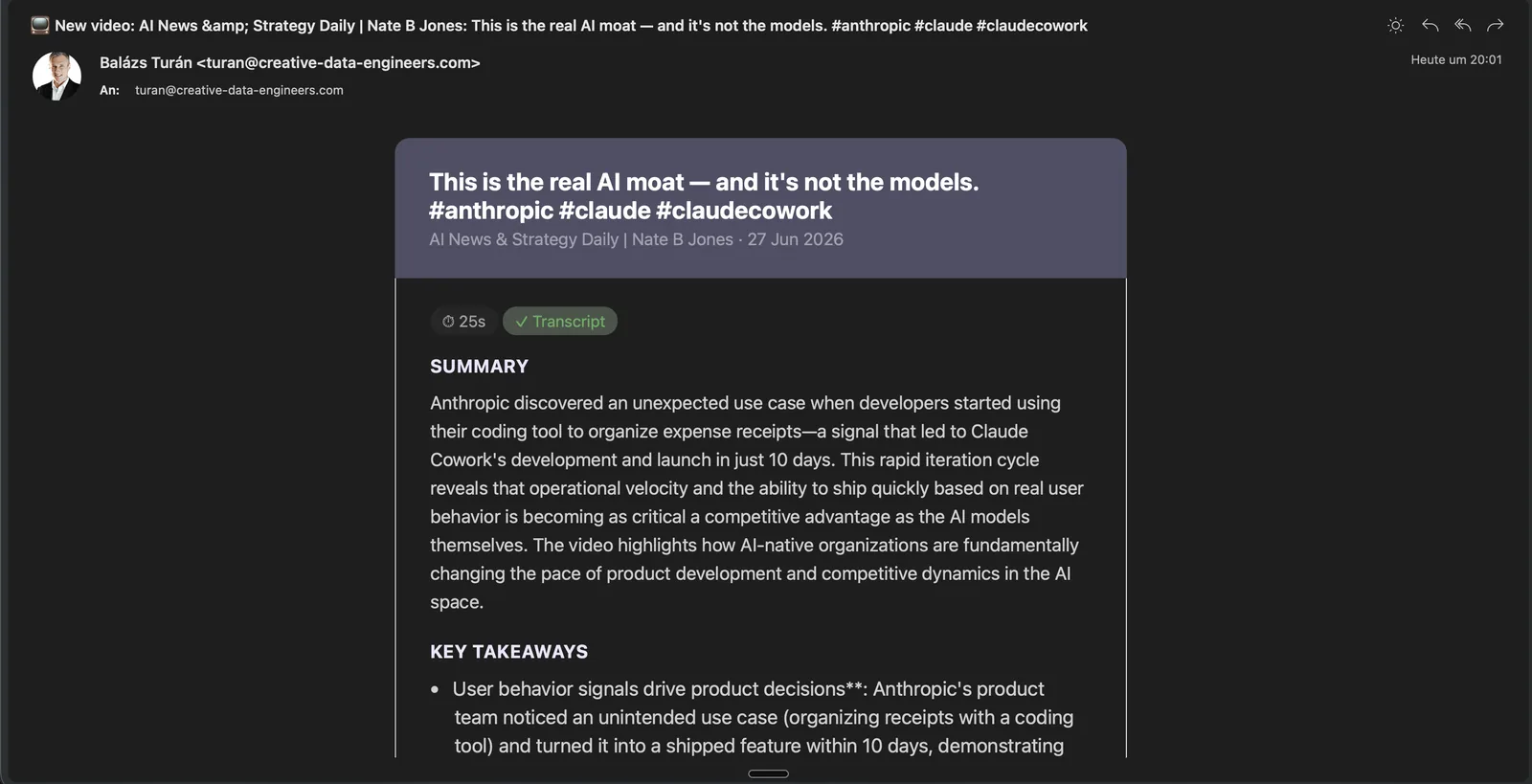
This is a real summary the daily job emailed me: the video, a short summary, and the key takeaways, as a clean HTML email.
Following more YouTube channels than I can watch eats my evening. So I built a daily digest: every day at 18:00 it checks my tracked channels for new uploads, summarizes each one with Claude, and emails me a clean digest. The public signup form is a teaching demo of the same pattern. This is the system, end to end.
Published June 2026 by Balázs Turán, Creative Data Engineers.
I follow more YouTube channels than I can sit down and watch. Most days I either fall behind or skim titles and miss the substance. A daily digest fixes that: it reads the new uploads for me and sends back a few sentences plus the key points, so I can decide what is worth my time in a minute.
So the real system is a personal tool. It runs every day on a schedule, checks each channel for new uploads, and only summarizes what it has not seen before. The public form on the landing page is a smaller, scoped version of the same idea, built to show how the signup-to-first-summary flow works without me opening up my API key to the whole internet.
Two flows share one repo. The real system is the daily digest at the top: a scheduled job that watches my channels and emails me summaries of new uploads. The teaching demo is the signup form at the bottom: it sends one summary when someone subscribes, on my personal key, so it is a deliberately small demo of the pattern.
Hover or focus any box for a plain-language explanation.
This is one of the systems we run in-house. For another, see the AI-search radar that writes our newsletter →
This is a real summary the daily job emailed me: the video, a short summary, and the key takeaways, as a clean HTML email.
RSS plus a Notion ledger is cheap, reliable new-video detection. YouTube's per-channel RSS feed lists recent uploads for free, and a Notion ledger of what I have already summarized means each run only touches new videos. No polling the paid API for every check.
A one-summary demo on a personal key keeps costs sane. The public form sends exactly one summary on signup. That shows the whole pattern without turning my personal API key into a free service for the whole internet.
The daily digest is the real value. The signup form is the demo, but the tool I open every morning is the digest. I built the thing I would actually use first, then exposed a slice of it to teach the pattern.
No. The web form is a teaching demo that runs on my personal API key, so it sends one summary per signup. The daily digest is my own personal tool. A version that runs for a whole team is client work.
A Notion ledger of processed videos. Before summarizing, each run checks what is already in that store and skips anything it has seen, so no video gets summarized twice.
It runs on my personal API key, which is exactly why the public form sends only one summary per signup. The daily digest covers just my own channels, so the cost stays small and predictable.
Yes. It is the same engineering we bring to client work: read the sources that matter, process them cleanly, and deliver something useful on a schedule. Book a call and we will scope it.
The digest runs on the same skills we bring to client work: wire up the right sources, keep the data clean, and deliver something useful without anyone babysitting it. That is the engineering behind our AI Search Visibility work too.
We also teach operators to build systems like this, hands-on. Balázs runs the build sessions at Agent-J+.